
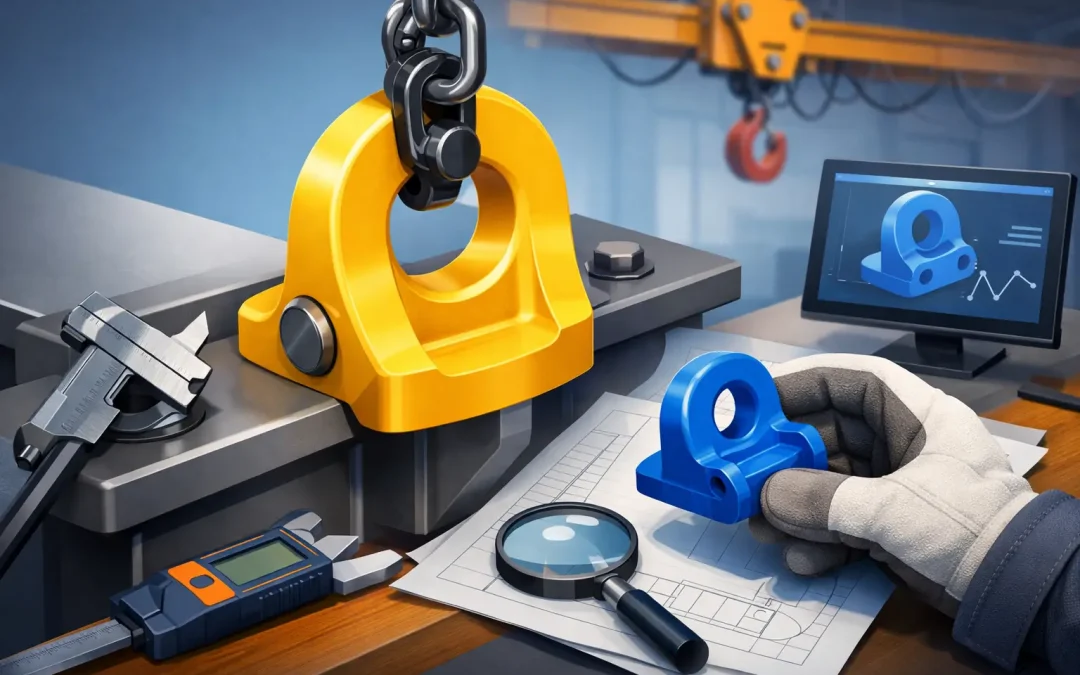
A lifting lug can hold up a shutdown, a steel install, or a vessel move for one simple reason – no one can produce the paperwork. If you need to know how to certify lifting lugs, the real answer is not just testing metal. It is confirming the lug was designed correctly, installed correctly, inspected correctly, and documented well enough to satisfy the job, the engineer, and the inspector.
On active projects, that usually comes to a head fast. The lug is already welded on. The pick is scheduled. The site inspector asks for proof. Now the question is not whether the lug looks strong. The question is whether it can be certified for the specific use and backed by defensible documentation.
What certification of a lifting lug actually means
Certification is not a generic stamp that says the lug is good forever. A certified lifting lug is typically supported by a combination of engineering review, material and weld verification where required, dimensional inspection, and proof load testing when the project or governing standard calls for it.
That matters because lifting lugs are not off-the-shelf hardware in many cases. A lot of them are fabricated for a specific tank, frame, skid, pipe spool, or structural component. Their capacity depends on more than plate thickness. Hole size, edge distance, weld size, base material, load angle, attachment geometry, and intended rigging configuration all affect whether the lug is acceptable.
In other words, certification is tied to the application. A lug that works for one pick orientation may not be acceptable for another. A lug rated for a vertical lift may not be suitable if the rigging introduces side loading or an angle that was never part of the design basis.
How to certify lifting lugs on a real job
If you are figuring out how to certify lifting lugs for a current project, start with the question the inspector will ask first: what is this lug supposed to lift, and under what conditions?
That sets the basis for the certification process. From there, the work usually follows a practical sequence.
Define the required load and lift configuration
Before any testing starts, the required working load limit has to be clear. That includes the weight of the item being lifted, load distribution if multiple lugs are involved, and the actual rigging geometry. Sling angles change forces. So does the center of gravity. So does whether the lift is static, repeated, or subject to field conditions that create shock loading.
If those conditions are not nailed down, the certification can miss the real demand on the lug. That is one of the most common jobsite problems. People focus on total weight and ignore how the load reaches each lug.
Confirm the lug design
For custom fabricated lugs, design review is often the first serious gate. Someone qualified needs to verify that the lug geometry and attachment method support the intended load. Depending on the project, that may involve reviewing drawings, weld details, material specs, and any engineered lifting calculations.
This step is where many delays start. If the lug was field-fabricated without complete records, certification gets harder. It does not always stop the process, but it may require additional inspection, engineering input, or more conservative assumptions.
Inspect fabrication and installation
A proof load test does not erase bad fabrication. Before testing, the lug and its attachment should be inspected for obvious defects, dimensional issues, weld quality concerns, distortion, or signs that the installed condition does not match the intended design.
That inspection may be visual only, or it may call for additional examination depending on the application and specification. If the lug is welded to a critical structure, the weld details matter just as much as the lug plate itself. The strongest plate in the world does not help if the attachment fails first.
Perform proof load testing when required
For many projects, proof load testing is the step that turns assumptions into documented evidence. A controlled test applies a specified test load to verify that the lifting lug and attachment can handle the required demand without unacceptable deformation or damage.
The exact test load is not something to guess at. It should follow the applicable project requirement, engineering instruction, or governing standard. In some cases that means testing at a percentage above rated load. In others, the required approach depends on whether the lug is a below-the-hook device component, a structural attachment, or part of a project-specific engineered lift system.
That is why certification is never one-size-fits-all. The right test method depends on what the lug is, how it will be used, and what the approving authority expects to see.
What proof load testing does and does not prove
Proof load testing is valuable, but it has limits. It demonstrates that the lug performed under the test conditions. It does not automatically certify every possible future use, every rigging angle, or every modification made after the test.
That distinction matters on jobs where lugs are reused, relocated, or altered in the field. If the hole is torch-modified, the weld is changed, or the lift plan changes materially, the original certification may no longer apply. The same issue comes up when a lug tested in a straight-line pull is later used in a multi-leg configuration with different force paths.
Testing is strongest when it matches actual service conditions as closely as practical. When that is not possible, the documentation needs to clearly state the basis and limits of the certification.
The paperwork required to certify lifting lugs
If the question is how to certify lifting lugs in a way that survives inspection, documentation is where the job is won or lost. A passing test without usable paperwork can still leave equipment sitting idle.
The final package often includes the lug identification, location, rated capacity, description of the supported structure, test method, test load, date, inspection findings, and the name of the qualified party performing or reviewing the work. Depending on the job, you may also need sketches, stamped calculations, weld records, material traceability, or photos from the setup and test.
The level of paperwork depends on the project. A routine industrial lift may accept a straightforward proof load test certificate with supporting notes. A refinery, port, defense, or heavily engineered construction environment may require a much more detailed package. If the customer, GC, or site safety team has a documentation format they expect, that should be addressed before testing starts, not after.
Common reasons lifting lug certification gets rejected
Most failed certification efforts are not caused by the lug snapping in a test. They fail because the process was incomplete.
One common issue is missing design basis. No one can show what the lug was rated for, what load path was assumed, or whether the weld was sized for the demand. Another is poor identification. If there are several similar lugs on a structure and the paperwork does not clearly identify which ones were inspected or tested, the certification may not be accepted.
Load angle is another problem. A lug may be tested for one condition and then submitted for a different lift scenario. Inspectors catch that. So do engineers. There is also the simple issue of timing. Teams often wait until the day before a pick to solve a paperwork problem that should have been addressed as soon as the lugs were fabricated.
When field service makes the difference
Lifting lug certification is rarely convenient. The part may already be installed. The vessel may be in the yard. The structure may be too large or too urgent to move offsite. That is why mobile testing support matters.
For contractors and operators in San Diego, field-capable proof load testing can remove days of delay from the process. Instead of pulling equipment apart or trying to coordinate offsite logistics, the testing and certification work can be performed where the asset is located, with the documentation turned around fast enough to support inspection schedules. That is the practical value behind a service model like Pacific Load Testing – getting you compliant without adding more downtime.
Before you schedule certification
The fastest certification jobs usually have three things ready: the required capacity, the intended lift configuration, and any available drawings or fabrication records. If you have those, the path is usually straightforward. If you do not, certification may still be possible, but expect more review and less room for guesswork.
That is the real answer to how to certify lifting lugs. Treat the lug like a critical lifting component, not just a piece of welded plate. When the design, inspection, testing, and paperwork line up, the approval process moves a lot faster – and so does the job.