
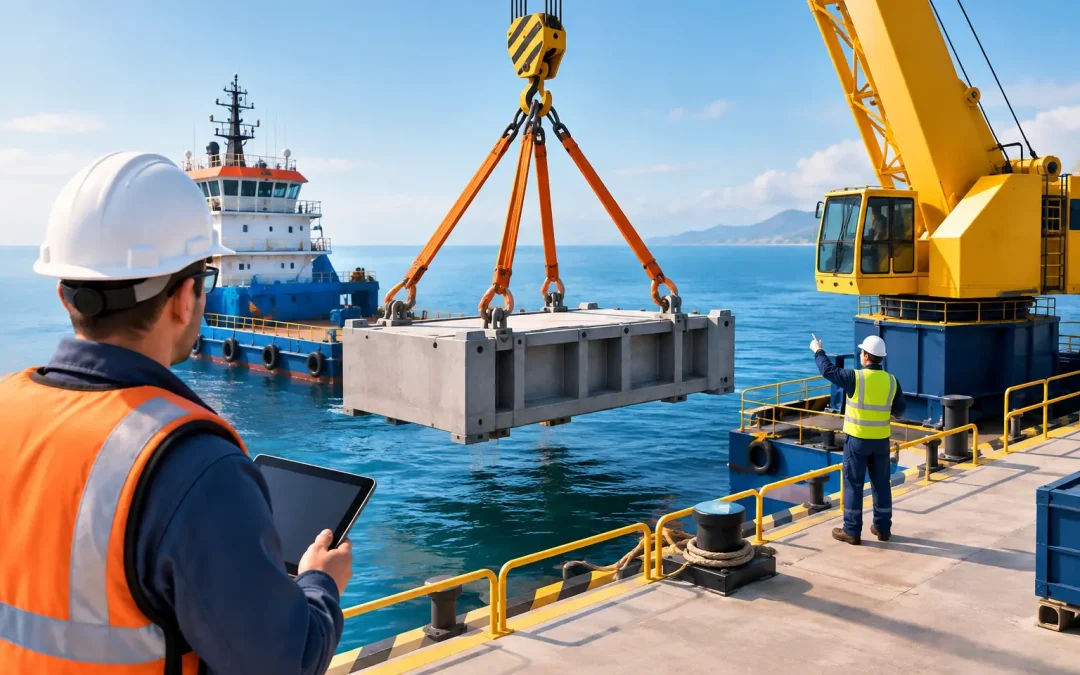
A load can be ready to move, the crew can be staged, and the vessel or jobsite can still sit idle for one missing item: current proof load documentation. In marine work, lifting equipment is exposed to salt, weather, vibration, hard use, and changing job conditions. Marine lifting compliance is what confirms that the gear, supporting system, and records are ready before an inspector, owner representative, or site safety lead asks for them.
For contractors, rigging crews, port operators, and maintenance teams, compliance is not paperwork for its own sake. It is the approval path that keeps material moving without creating an avoidable safety exposure or schedule delay.
What Marine Lifting Compliance Covers
Marine lifting work can involve vessel cranes, davits, hoists, padeyes, lifting beams, spreader bars, slings, shackles, chain falls, rigging assemblies, and purpose-built lifting fixtures. The exact compliance requirement depends on the lift, the equipment owner, the work location, the governing authority, and the project specification.
A lift at a waterfront construction site may be governed by a different mix of requirements than a shipboard equipment installation or a port maintenance project. That difference matters. A current certificate for an individual shackle does not automatically establish that a custom lifting frame, its connection points, and the complete rigging arrangement are approved for a specific critical lift.
The working question is straightforward: what needs to be inspected, tested, identified, and documented before this equipment can be released for use? Get that answer early. Waiting until the inspector is onsite is how small documentation gaps become lost shifts.
The Marine Environment Changes the Risk
Saltwater exposure can accelerate corrosion. Paint can hide damaged welds or pitting. Hardware markings may become difficult to read, and gear that has been moved between jobs can lose its traceable records. Marine operations also frequently deal with restricted access, limited deck space, swing hazards, dynamic movement, and lifts near people, structures, or water.
That does not mean every piece of gear needs the same level of review. It means the inspection and testing plan must fit the actual equipment and the actual lift. A routine material-handling lift and a one-time engineered lift of a high-value component should not be treated as identical jobs.
Proof Load Testing Is a Practical Compliance Check
Proof load testing applies a controlled test load to verify that lifting equipment or an assembly performs as intended under a specified load. It is commonly required for new, modified, repaired, custom-fabricated, or project-specific lifting equipment. It may also be required when an owner, inspector, engineer, or contract specification calls for documented verification before use.
The test load, hold period, setup, acceptance criteria, and reporting requirements should be established before testing begins. Those details are not interchangeable. A test performed at the wrong load or without the required identification may not satisfy the party reviewing the certificate.
A proper testing process also includes a pre-test visual review. Test loading is not a substitute for looking for deformation, cracking, damaged components, unreadable markings, improper assembly, or conditions that make a test unsafe. If the equipment needs repair or engineering review, forcing it through a test is not the answer.
For field crews, the value is simple: proof load testing produces objective evidence that the equipment was tested to the required condition and load. When the result is documented correctly, the project team has a clear record for its compliance file.
The Certificate Must Match the Equipment
A certificate is only useful when it can be tied directly to the item being used. In marine lifting compliance, identification and traceability are often where otherwise capable crews run into trouble.
Each certificate should clearly connect to the equipment through a serial number, asset number, tag, stamped marking, or other durable identifier. For an assembly, the record should identify the assembly and, when required, the key components that make up the tested configuration. Describing an item only as “lifting beam” or “rigging set” may not be enough when multiple similar items are on the same site.
Good records commonly capture the equipment description, identifying number, safe working load or rated capacity, test load, test date, test method, result, and the testing provider’s information. Project requirements can call for additional details, including photographs, measurement data, engineer approval, or repair history.
Keep the certificate with the project records and make it available to the people who need it. A clean PDF in the supervisor’s inbox does not help much if the field team cannot produce it during an inspection. Confirm who will retain the original record, who will have a jobsite copy, and how expired or superseded certificates will be controlled.
Plan Testing Before the Equipment Reaches the Dock
The fastest compliance work is planned before the gear becomes critical path. As soon as a custom fixture is fabricated, a crane component is repaired, or a project calls for specialized rigging, review the testing requirement and schedule the service.
Mobile testing can reduce transport time and avoid taking equipment out of a tightly controlled work area. Pacific Load Testing brings proof load testing service to the jobsite, helping San Diego-area teams coordinate testing around vessel access, delivery windows, crane availability, and inspection dates.
Before scheduling, have the essential job details ready: the item or assembly to be tested, rated capacity, required proof load, dimensions and weight, location, available access, desired test date, and any project-specific documentation requirements. Photos are often useful for confirming setup needs, especially for unusual lifting points or large fabricated equipment.
Site conditions matter just as much as paperwork. The test area needs enough room for safe setup, controlled access, and a stable method to apply and measure the load. On a vessel or crowded waterfront site, that may require coordination with operations, security, other trades, and the person controlling the work area.
Common Problems That Stop Approval
Most compliance delays are preventable. They happen when equipment arrives without identification, documentation is incomplete, or teams assume a prior test covers a changed configuration. Watch for these recurring issues:
- A lifting device has no readable asset number or serial number to connect it to the certificate.
- A repair, weld modification, or alteration was made after the last documented test.
- Components from different rigging sets are combined without confirming that the assembly remains suitable for the intended lift.
- The certificate shows a test result but does not state the required test load, capacity, or equipment description.
- The project calls for a test before use, but testing is scheduled after the inspector or vessel window has already arrived.
None of these problems automatically means the equipment is unusable. They do mean that work may pause while the team verifies capacity, establishes traceability, completes testing, or obtains the correct review. The earlier the issue is found, the more options the project has.
Compliance Depends on the Lift, Not Just the Gear
Rated capacity is essential, but it is only one part of a compliant lift. The full lift also depends on load weight, center of gravity, sling angle, connection method, side loading, clearance, environmental conditions, and the capacity of every component in the load path.
For example, a lifting beam may have a current proof load certificate, yet the planned lift can still be unsuitable if the padeyes are loaded differently than designed or if the selected shackles do not fit the connection properly. Likewise, a rigging assembly that was appropriate for a previous lift may not be appropriate after a change in sling angle or load configuration.
This is where project planning, qualified rigging judgment, and documented testing work together. Testing verifies a defined item or assembly. It does not replace lift planning or authorize use beyond the equipment’s intended configuration and rated limits.
When Requirements Are Not Clear
Do not guess based on the last job. Ask the owner, inspector, engineer, general contractor, or project safety representative what standard and deliverable they require. Confirm whether they need proof load testing, a visual inspection report, a certificate of conformance, engineering review, or a combination of these records.
The answer may depend on whether the equipment is off-the-shelf, custom fabricated, repaired, permanently installed, or being used for a critical lift. It may also change based on customer policy or contract language. Clear requirements before testing prevent a second mobilization and keep the certification package aligned with the job.
A marine lift rarely gets easier once the crew, cargo, and vessel schedule are all in motion. Identify the equipment early, confirm what the inspector will need, and get the testing record in place before the lift becomes the reason work stops.