
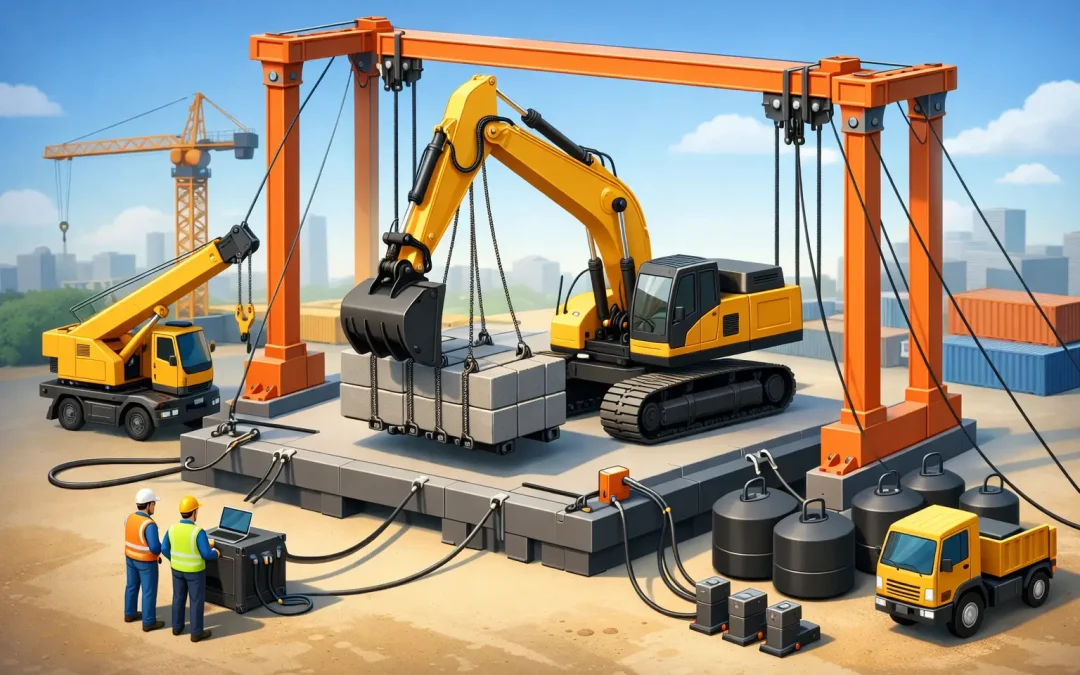
A failed inspection rarely starts with a major breakdown. More often, it starts with missing paperwork, an unverified lifting point, or equipment that was put into service without documented proof of capacity. That is why construction equipment load testing matters on active jobsites. It gives contractors, rigging teams, and project supervisors the certification they need before a lift becomes a liability.
What construction equipment load testing actually covers
In practical terms, construction equipment load testing is the process of applying a verified test load to equipment or lifting-related systems to confirm that they can perform as required. The goal is not guesswork and it is not a visual check alone. It is documented proof that the equipment or structure has been tested to a specified capacity under controlled conditions.
On construction and industrial sites, that can apply to more than one category of equipment. It may involve below-the-hook lifting devices, rigging components, spreader bars, davit systems, pad eyes, hoists, anchor points, or other load-bearing assemblies that must be certified before use. In some cases, the requirement comes from a project engineer. In others, it comes from an inspector, a site safety requirement, or a customer specification.
That distinction matters. A lot of jobsite teams assume a manufacturer rating, a recent purchase, or a clean visual condition is enough. It often is not. When the project calls for proof load certification, the documentation has to match the equipment, the load, and the required standard.
Why inspectors ask for construction equipment load testing
Most crews do not request testing because they want another admin task. They request it because work stops without it. When an inspector asks for proof load documentation, they are looking for evidence that the equipment has been evaluated beyond appearance and tagged capacity.
That is especially true on high-risk lifts, custom fabricated devices, modified equipment, and jobsite-specific lifting systems. If a component has been repaired, altered, relocated, or built for a special application, previous paperwork may no longer satisfy the requirement. The same issue comes up when documentation is incomplete, outdated, or tied to a different asset than the one on site.
Load testing also protects the contractor’s position when multiple parties are involved. On a typical commercial or industrial project, the GC, subcontractor, safety team, engineer, and owner may all want confirmation before approving use. Clear certification reduces disputes and keeps decisions tied to documented facts.
What the process looks like on a real jobsite
Good testing work is not just about applying weight. It starts with identifying exactly what is being tested, what standard or project requirement applies, and what load level must be achieved. If any of that is unclear, the test can create more problems than it solves.
A proper field process usually includes equipment identification, review of available specs or drawings, setup of calibrated test weights or test methods, controlled loading, observation of performance, and final documentation. Depending on the asset, the technician may also inspect welds, attachment points, hardware, structural condition, labeling, and overall configuration before the test even begins.
The site conditions matter too. Testing in a yard with open access is different from testing on an active commercial project, in a plant, or at a marine facility. Space, rigging access, surface conditions, crane support, and the presence of other trades can all affect the schedule. That is one reason mobile service is valuable. If the testing team can work where the equipment already sits, project crews avoid extra transport, delays, and handling.
Not every piece of equipment is treated the same
This is where a lot of confusion happens. Contractors use the phrase load testing broadly, but the requirements vary by equipment type, manufacturer guidance, site rules, and governing standards. A spreader bar does not get treated the same way as a hoist. A fixed lifting point is not evaluated the same way as a portable rigging assembly.
Some equipment needs proof loading at a defined percentage above rated capacity. Other equipment may require operational checks, inspection criteria, or engineering review in addition to the test itself. Custom fabricated items usually need extra attention because there may be no off-the-shelf documentation to rely on. If there has been a field modification, the original paperwork may not apply at all.
That is why speed alone is not enough. Fast turnaround is useful only if the certification is correct for the equipment in front of you.
Common reasons projects get delayed
The biggest delays usually come from avoidable issues. The first is waiting too long to schedule testing. If the lift plan is already approved but the proof load certification was never arranged, the crew can be standing by while the paperwork catches up.
The second issue is incomplete information. When the testing provider arrives and no one can confirm capacity, application, or ownership of the device, the process slows down immediately. Missing drawings, unclear asset IDs, and uncertain load requirements all add time.
A third problem is assuming a test done somewhere else will satisfy the current job. Sometimes it will. Often it will not. If the equipment was altered, if the project specification is different, or if the inspector wants fresh documentation, old records may not help.
Then there is logistics. Some teams remove equipment from the field and send it off site, only to lose a day or more in transport and staging. For time-sensitive work, on-site service is usually the cleaner option because it keeps the asset close to the point of use and reduces downtime.
How to prepare for load testing without slowing down the crew
If you know testing will be required, get ahead of it before the inspector asks for the certificate. Confirm exactly what equipment needs proof load testing, who is requesting it, and what documentation the site will accept. That step alone saves rework.
It also helps to gather the basic asset details in one place. Capacity, dimensions, serial numbers, tags, drawings, and any prior test records should be available before the technician arrives. If the equipment is custom, repaired, or modified, say so early. That is not a small detail. It often determines how the test is structured and what backup information is needed.
On the site side, make sure access is ready. If the equipment is buried behind stored material, tied into another operation, or blocked by scheduling conflicts, a simple test can turn into half a day. Crews do not need a perfect setup. They just need a workable one.
Choosing a provider for construction equipment load testing
For most contractors, the decision comes down to one question: can this company get us certified correctly and fast enough to keep the job moving? That is the right question.
A good provider should understand lifting applications, field conditions, certification requirements, and jobsite urgency. They should also be able to work through the practical issues that show up on real projects, including tight access, short notice, and equipment that does not arrive with clean paperwork.
What you want is not a generic testing vendor. You want a service partner who can verify the requirement, perform the test, and issue documentation that stands up to inspection. In the San Diego market, Pacific Load Testing is built around that need, with mobile proof load testing service designed to help contractors and operators get compliant without dragging equipment all over town.
When load testing is worth doing early
If the equipment is new to the job, newly fabricated, repaired, modified, or tied to a critical path activity, earlier is better. The closer testing happens to the planned lift date, the less room there is to fix a problem if something is missing.
Early testing also helps when several departments need the same documentation. Safety, operations, quality, and ownership teams often move at different speeds. Getting certified ahead of the final inspection gives everyone time to review what they need without stopping field work.
The larger point is simple. Construction schedules do not usually fail because one task is hard. They fail because a handful of small requirements stack up at the wrong time. Load testing is one of those requirements that should be handled before it becomes urgent.
When lifting equipment is part of the plan, treat certification like any other critical jobsite dependency. Get the test done, get the paperwork in hand, and keep the work moving.