
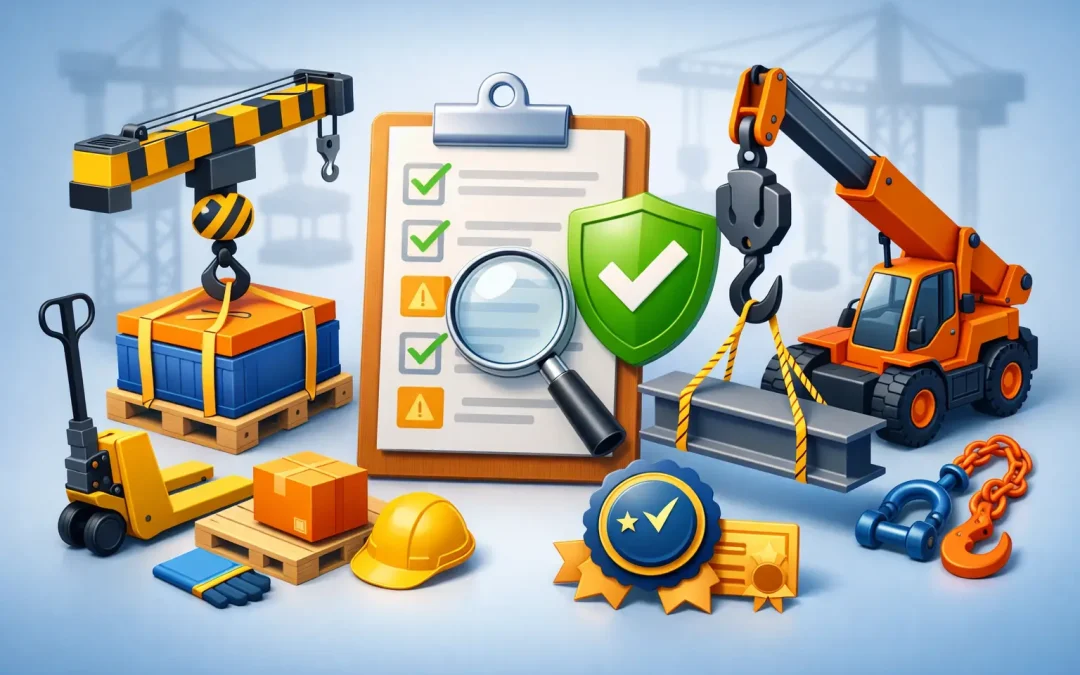
If an inspector asks for certification and your paperwork is missing, the job can stop right there. That is why lifting equipment certification requirements matter long before the first lift. For contractors, rigging crews, maintenance teams, and port operators, the issue is not just safety. It is whether your equipment can be approved for use without slowing down the schedule.
What lifting equipment certification requirements actually cover
In the field, people often use the word certification to mean a few different things. Sometimes they mean proof load testing with documented results. Sometimes they mean a periodic inspection record. Sometimes they mean manufacturer information, repair documentation, or a tagged and traceable lifting device that meets the project spec.
That distinction matters. There is no single universal document that covers every piece of lifting gear in every situation. Requirements depend on the equipment, how it is used, who owns the site, and what standard the inspector or project manager is working from.
For most job sites, lifting equipment certification requirements come down to one basic question: can you prove that the equipment or lifting system has been tested, inspected, and approved for the intended load and application? If the answer is yes, work moves. If the answer is unclear, expect delays.
The documents inspectors usually want to see
Most inspection-driven projects are looking for clear, current, and traceable documentation. That usually includes proof load test certificates where required, identification of the equipment tested, rated capacity, test load applied, date of service, and the party that performed the work.
In many cases, the supporting records matter just as much as the certificate itself. Inspectors may ask for serial numbers, equipment tags, repair history, prior test data, or confirmation that modifications did not change the equipment’s rated use. A certificate with vague equipment identification is often where problems start.
The practical point is simple. Your paperwork needs to match the equipment on site, and it needs to be legible, current, and easy to hand over when requested.
Certification is not the same as a visual check
A visual inspection can catch obvious wear, deformation, cracked welds, corrosion, missing labels, or damaged components. That is necessary, but it is not the same as a proof load test. A load test is intended to verify performance under a specified test load and produce documentation that can be used for compliance and approval.
Some equipment only needs routine inspection unless a governing standard, customer requirement, alteration, repair, or incident triggers load testing. Other equipment or lifting assemblies may need documented proof load testing before first use, after fabrication, after major repair, or before acceptance on a regulated project.
That is where many teams get caught off guard. They assume a recent inspection tag covers everything. It often does not.
When proof load testing is typically required
The need for proof load testing depends on the application. Below are common cases where certification requirements become more demanding.
New or fabricated lifting devices
If you are putting a newly fabricated beam, spreader bar, below-the-hook device, pad eye system, or custom rigging assembly into service, expect documentation requirements to be stricter. Custom gear usually needs to be tested and documented before it is accepted for use.
That is especially true on commercial construction, industrial shutdowns, shipyard work, and public-sector projects where engineering review and field acceptance go together.
After repair or modification
Once lifting equipment has been repaired, re-rated, or modified, previous certification may no longer be enough. Welding, structural changes, component replacement, and load path changes can all trigger a requirement for retesting.
This is one of those it-depends situations. A minor like-for-like replacement may not create the same burden as a structural repair. But if the change affects capacity or integrity, updated testing and records are usually expected.
Project-specific or site-specific acceptance
Some owners, general contractors, and site safety teams require proof load testing documentation even when a general standard leaves room for interpretation. Ports, military work, utilities, large commercial builders, and heavy industrial sites often have their own acceptance rules.
In those cases, the only requirement that matters is the one tied to site approval. If the project spec says provide proof load certification before use, that is the standard you have to meet to get moving.
Equipment involved in an incident or questionable condition
If equipment has been shock loaded, overloaded, damaged, or taken out of service for a safety concern, testing may be required before it goes back into operation. The same goes for lifting devices with unreadable capacity markings or unclear service history.
Trying to reuse questionable equipment without updated documentation is usually where downtime gets worse, not better.
Common equipment that may need certification
The exact scope varies, but contractors regularly need documentation for spreader bars, lifting beams, hoist rings, pad eyes, shackles used in critical applications, custom rigging fixtures, davits, hoists, crane attachments, and below-the-hook lifting devices.
Not every shackle or sling on a site gets treated the same way as a fabricated lifting beam. Off-the-shelf rigging hardware may fall under manufacturer ratings and periodic inspection rules, while custom assemblies often require more formal testing and records. That difference is worth sorting out early, before an inspection turns into a hold point.
Where teams lose time on compliance
Most delays do not happen because nobody cared about certification. They happen because the process started too late or the paperwork package was incomplete.
A common problem is waiting until the inspector asks for documents. By then, equipment may already be staged, crews are scheduled, and a missed approval window starts affecting other trades. Another issue is assuming an old certificate is still acceptable even though the device was altered, repainted without visible ID, or moved onto a project with stricter submittal requirements.
There is also the field reality of logistics. Moving large lifting devices off site for testing can create its own delay. When the schedule is tight, mobile service can make the difference between same-week approval and a costly standstill.
How to stay ahead of lifting equipment certification requirements
The fastest path is to treat certification like part of pre-job planning, not a last-minute admin task. Before equipment arrives at the point of use, confirm exactly what the project requires and match those requirements to the equipment list.
Start by identifying what is standard equipment and what is custom or recently repaired. Then check whether each item has current identification, supporting documentation, and any proof load test records the project may ask for. If a device has no traceable paperwork, solve that before it reaches inspection.
It also helps to keep one organized file for each lifting device or assembly. Include the asset ID, rated capacity, drawings if applicable, prior testing, repair records, and current certification. When an inspector asks, you should be able to produce the file without chasing three different departments.
Work from the site requirement backward
The cleanest way to avoid rework is to start with the owner or project requirement, then build the testing scope around it. If the site wants proof load certification for a custom beam, the question is not whether somebody on the crew thinks it is unnecessary. The question is what documentation gets approval.
That mindset saves time. It avoids doing partial compliance work that still fails the submittal or field review.
Choosing a testing partner matters
For high-intent jobs, speed matters, but credibility matters just as much. The provider needs to understand lifting applications, documentation standards, and what inspectors actually look for. Fast service is useful only if the paperwork holds up in the field.
This is where a practical, mobile approach helps. Pacific Load Testing works with contractors and operators who need proof load testing and certification without pulling focus from the job. On-site service reduces handling, cuts downtime, and makes it easier to get the right equipment tested where the work is happening.
The best time to set that up is before the equipment becomes a bottleneck. Once a lift plan, shutdown window, or inspection date is fixed, every hour counts.
The real standard is readiness
There is no shortcut around documentation when lifting equipment is under review. But there is a better way to handle it. Know what the site requires, know which equipment needs proof load testing, and make sure the paperwork is tied clearly to the asset in the field.
If your team treats certification as part of operational readiness, inspections go faster and schedules hold together. That is usually the difference between equipment that is technically available and equipment that is actually approved to work.