
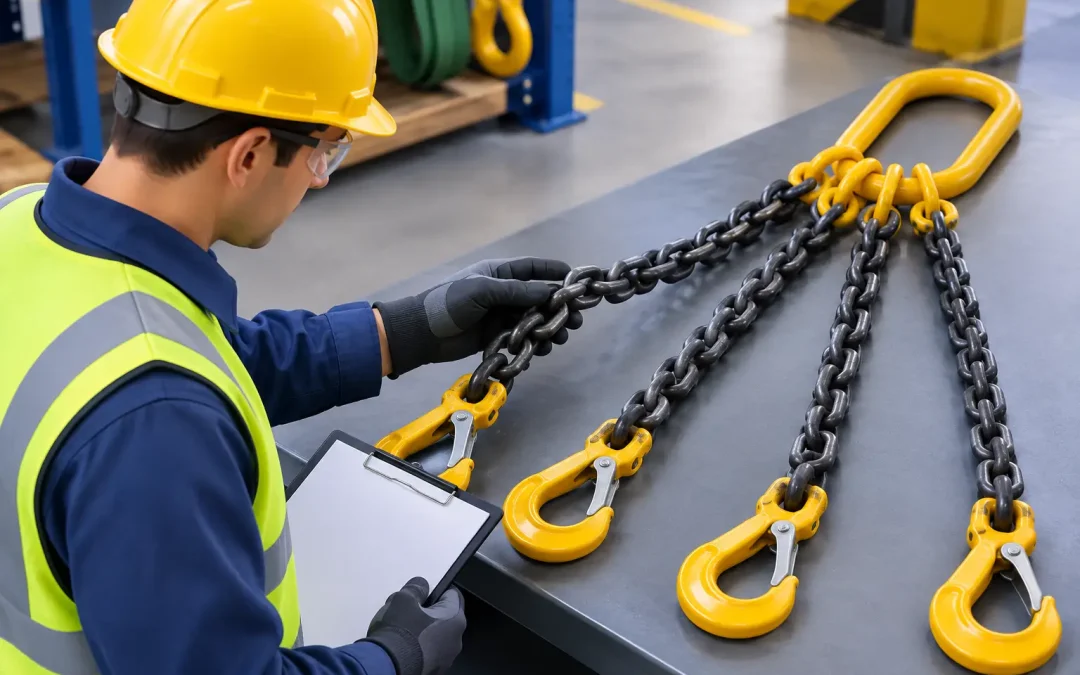
A chain sling can look serviceable from a few feet away and still be unfit for the lift. One stretched link, a damaged hook latch, or missing identification can turn a routine pick into a dropped-load hazard and a jobsite delay. Knowing how to inspect chain slings gives the person in charge a clear decision before the load leaves the ground: use it, remove it from service, or send it for qualified evaluation.
Chain slings are built for tough work, but they are not indestructible. Heat, side loading, shock loading, corrosion, abrasion, unauthorized repair, and repeated use all leave evidence. A proper inspection is not a quick glance while the crane is waiting. It is a hands-on check performed by a trained, designated person under adequate light.
Start With the Sling Tag and Configuration
Before examining individual links, verify that the sling is identifiable and appropriate for the planned lift. Every alloy steel chain sling should have a durable identification tag or marking that provides the manufacturer or assembler identification, chain grade, size, rated capacity, number of legs, and reach. The tag must be legible.
If the identification is missing or unreadable, do not guess at capacity based on chain appearance. Remove the sling from service until it can be properly identified and evaluated. A chain that resembles Grade 80 or Grade 100 is not proof of its grade, working load limit, or approved configuration.
Confirm that the sling configuration matches the lift. A two-leg, three-leg, or four-leg sling does not automatically carry its maximum rated load in every setup. Sling angle reduces capacity, and unequal loading can put more force on one leg than the others. Check the intended hitch type, the angle from horizontal, the load’s center of gravity, and whether hooks or fittings will be side loaded.
How to Inspect Chain Slings Link by Link
Lay the sling out where it can be fully seen and handled. Clean off mud, paint buildup, grease, or other material that could hide damage. Start at the master link or top assembly and work down each leg without skipping around. Run a gloved hand along the chain while looking closely at every link, hook, coupling link, and attachment.
Look for these conditions:
- Stretched, elongated, bent, twisted, or cracked chain links
- Gouges, nicks, deep wear, cuts, arc strikes, weld spatter, or excessive corrosion
- Links that bind, do not articulate freely, or show heat discoloration
- Wear that has reduced chain diameter beyond the manufacturer or applicable standard limits
- Hooks that are opened, twisted, cracked, worn, or missing a functioning safety latch where required
- Bent, cracked, or worn master links, subassemblies, couplers, and connecting hardware
- Evidence of welding, grinding, heating, or repair not performed and approved by the manufacturer
Pay special attention to high-contact areas. Chain links wear fastest where they bear on hooks, shackles, load edges, and other links. Hooks commonly show damage at the throat, saddle, and tip. A hook with an enlarged throat opening or twist is a warning that it may have been overloaded or side loaded.
Do not treat rust as merely cosmetic. Light surface oxidation may be manageable after cleaning and evaluation, but heavy corrosion can reduce material section and hide pitting. If corrosion is significant, remove the sling from service rather than trying to make a field judgment based on appearance alone.
Check for Stretch and Deformation
Overloading often leaves permanent stretch. Compare suspect links with undamaged links of the same size, or use the manufacturer’s inspection criteria and measurement method. A link that is visibly longer, narrower, or distorted is not acceptable for lifting service.
Twisted chain is another stop-work condition. Chain links are designed to load in line. Twisting changes the load path, creates stress concentrations, and can indicate that the sling was used improperly. Never straighten a chain link in the field and return it to service. The same rule applies to a bent hook or master link.
Look for Heat and Electrical Damage
Alloy chain slings should be kept away from welding current and excessive heat unless the manufacturer has provided specific guidance for the exposure. Arc strikes, weld spatter, and blue, brown, or straw-colored discoloration can signal that the metal properties have been affected.
If a chain sling may have contacted an energized welding circuit, been exposed to fire, or worked near temperatures outside its approved range, tag it out and have it evaluated. Heat damage is not always obvious, and a visual check alone may not be enough to clear the sling for use.
Inspect Hooks, Latches, and Fittings as Carefully as the Chain
A sling is only as reliable as its weakest component. Check each hook to make sure the latch closes and bears properly against the hook tip. A latch is not designed to carry the load, but it helps retain the rigging in the hook while slack is introduced or the load shifts.
The hook body must not be cracked, bent, twisted, excessively worn, or opened beyond allowable limits. Never force a latch closed, field-weld a latch, or use a bolt, wire, or improvised clip as a replacement. If the latch does not work correctly, take the sling out of service.
Also inspect the master link and any intermediate links for proper fit. Components should sit naturally in the crane hook and connect without crowding, point loading, or forcing. Do not place more than one sling leg in a hook unless the hook is specifically designed and rated for that use. Avoid tip loading and side loading at every connection point.
Know When Inspection Is Required
A pre-use visual inspection should take place before each shift or each use, depending on the work environment and employer procedures. This frequent inspection is the front line for catching new damage from the last lift, transport, or storage cycle.
Periodic inspections are more formal and must be performed by a qualified person at intervals based on service conditions and applicable requirements. Normal service, severe service, and special or infrequent service do not carry the same inspection schedule. High-cycle work, corrosive environments, marine exposure, heat exposure, and rough handling call for more frequent documented review.
Follow your company program, the sling manufacturer’s instructions, OSHA requirements, and applicable ASME standards. When rules differ, use the more conservative requirement or get direction from the responsible safety authority. Written records for periodic inspections help establish equipment history and show that the rigging program is being managed, not improvised.
Remove Damaged Slings From Service Immediately
When a chain sling fails inspection, make it unavailable for use at once. Tag it clearly, segregate it from usable rigging, and notify the supervisor or rigging manager. Leaving a rejected sling near the gang box or crane basket invites someone to grab it when the schedule is tight.
Do not attempt unauthorized repairs. Chain links, hooks, and fittings require controlled materials, procedures, and inspection methods. A repair that looks clean can still alter heat treatment or reduce capacity. Only the manufacturer or a qualified repair facility should determine whether a sling can be repaired, re-rated, proof tested, or permanently removed from service.
For projects requiring documented proof load testing or certification, plan ahead. Testing is a separate requirement from a routine visual inspection, and a current inspection tag is not a substitute for documentation required by an owner, port, inspector, or project specification. Pacific Load Testing provides mobile proof load testing support for crews that need certified equipment without adding unnecessary downtime.
Make the Inspection Part of the Lift Plan
The best sling inspection happens before the crew is committed to the pick. Build it into the lift plan along with load weight, rigging capacity, sling angles, attachment points, travel path, exclusion zone, and communication method. That gives the rigger time to reject questionable gear without pressure from an idling crane or a waiting delivery truck.
Store chain slings off the ground, protected from traffic, moisture, and chemical exposure. Do not drag them across concrete, sharp edges, or steel decking. Use edge protection where needed, and do not shorten a sling by knotting it, twisting it, or placing chain links over a hook tip unless the sling assembly is specifically designed for that method.
A chain sling that is clearly identified, correctly selected, and free of damage supports a controlled lift. If there is any doubt about its condition or capacity, stop the lift and get the sling evaluated. Replacing or testing rigging takes less time than explaining a failed lift, an injury, or a shutdown.