
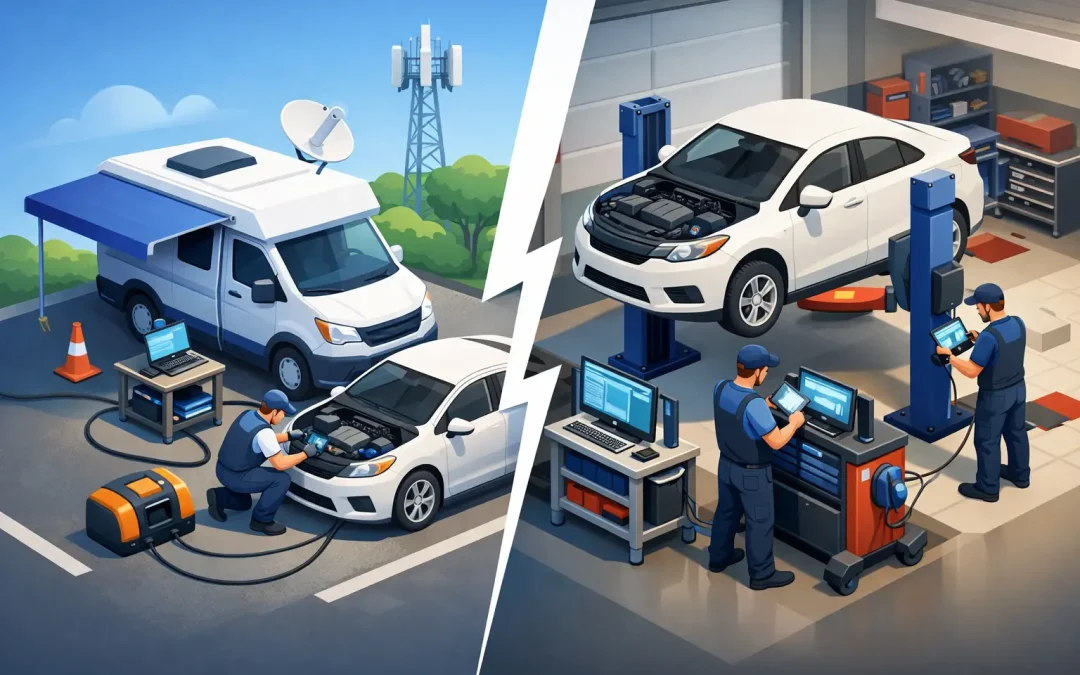
A failed inspection rarely happens at a convenient time. When a crane attachment, lifting beam, spreader bar, or rigging component needs proof load testing, the real question is not just whether it can be certified – it is how fast you can get that certification without slowing down the job. That is where mobile testing versus shop testing becomes a practical decision, not an abstract one.
For contractors, equipment managers, and project supervisors, the right choice comes down to downtime, access, transport, and documentation timing. Both options can serve a valid purpose. But they do not fit the same field conditions, and choosing the wrong one can add delay, cost, and unnecessary coordination.
Mobile testing versus shop testing on real jobs
Shop testing is the traditional model. Equipment is transported to a testing facility, evaluated under controlled conditions, and returned with the required documentation once testing is complete. In the right situation, that can work well.
Mobile testing brings the service to the customer. The testing team arrives at the jobsite, yard, port, plant, or staging area with the equipment and tools needed to perform proof load testing on location. For operations working on active schedules, that difference matters.
The biggest advantage of mobile service is simple – less disruption. If your lifting equipment is already on site, installed, staged, or tied into a tight sequence of work, removing it for off-site testing may create more problems than the test itself. Transport has to be arranged, labor has to be coordinated, and the schedule has to absorb the gap.
That does not mean shop testing is wrong. It means the best option depends on the equipment, the site, and how much room your schedule has for extra handling.
When mobile testing makes more sense
Mobile testing is often the better fit when downtime is the main concern. On active construction sites, marine terminals, industrial plants, and maintenance shutdowns, every handoff adds risk to the schedule. If the equipment can be tested safely and correctly on site, mobile service cuts out unnecessary movement.
This is especially useful when the item is large, awkward, or already positioned for use. A spreader beam, pad eye assembly, davit, hoist support, or custom lifting fixture may not be easy to remove and transport without additional equipment and labor. In those cases, sending the test team out is often faster than sending the equipment away.
Mobile testing also helps when documentation is needed quickly for inspection approval. If the inspector is waiting on proof load certification before a system can be cleared for use, time matters. On-site service can tighten that timeline because the equipment stays where it is, and the process moves around the job rather than the other way around.
There is also a control advantage. When testing happens at your location, your team can see the equipment condition, identify any access issues, and coordinate directly with the technicians performing the work. That can reduce confusion and shorten approval cycles, especially on projects where multiple parties are involved.
When shop testing is still the better option
There are situations where shop testing remains the smarter call. If the equipment is already off the job, stored in a yard, or part of a larger batch of components being processed together, a shop environment may be more efficient.
A controlled facility can also help when site conditions are limited. If the jobsite has poor access, restricted working room, unstable staging conditions, or operational conflicts that make testing difficult, moving the equipment to a shop may be the safer and more predictable path. Not every site is set up to support on-location testing without delays.
Shop testing can also make sense when additional repair, fabrication support, or detailed evaluation may be needed before certification. If the component is expected to need more than straightforward proof load testing, a shop may offer better support for the full scope of work.
The trade-off is time and handling. Once you remove equipment from service, transport it, unload it, test it, and return it, the clock keeps running. If your schedule has room for that, fine. If it does not, the shop route may cost more in downtime than it saves in convenience.
The real cost is not always the invoice
When people compare mobile testing versus shop testing, they often look at the direct service cost first. That is reasonable, but it is not the whole picture.
The bigger cost is usually tied to operations. If a crew is waiting, an inspection is on hold, or a lift plan cannot move forward until documentation is issued, downtime can outweigh any difference between testing methods. Transport costs, rental extensions, labor idling, and rescheduling other trades all add up fast.
That is why the lowest quoted price is not always the best value. A cheaper test becomes expensive if it adds a day or two of avoidable delay. For high-pressure jobs, speed and readiness often matter more than shaving a small amount off the service line item.
Compliance is only useful if it arrives on time
In lifting operations, certification is not paperwork for its own sake. It is what clears the equipment for use and gives inspectors, safety teams, and project managers the documentation they need to move forward.
That makes turnaround a major factor in the decision. If the testing method slows down documentation, it slows down the project. Mobile service is often attractive for that reason alone. It aligns the test with the actual work sequence instead of forcing the work to pause while the equipment is moved elsewhere.
For San Diego contractors and industrial operators, that can be the difference between staying on schedule and losing a day to logistics. Pacific Load Testing is built around that field reality. The value of mobile service is not just convenience. It is keeping certified equipment available where the work happens.
How to choose between mobile and shop testing
The right choice usually comes down to five practical questions.
First, can the equipment be tested safely and properly on site? If yes, mobile service may save significant time. If no, a shop may be necessary.
Second, how difficult is it to remove and transport the equipment? If moving it requires cranes, trucking, special handling, or disassembly, mobile testing usually becomes more attractive.
Third, how tight is your inspection or production schedule? If certification is needed immediately to keep work moving, on-site testing often has the advantage.
Fourth, what are the site conditions? Good access, stable setup, and clear coordination support mobile work. Congested or restricted sites may push the decision toward a shop.
Fifth, is the equipment expected to need more than testing? If repairs, modifications, or extensive bench evaluation are likely, shop service may be the more efficient route.
This is why there is no one-size-fits-all answer. The best choice depends on the field conditions and the consequences of delay.
Common mistakes when comparing the two
One common mistake is assuming shop testing is automatically more thorough. Quality depends on the testing process, the equipment used, and the competence of the provider – not just the location. A properly executed mobile test can meet the same compliance purpose as a shop-based one when the application allows it.
Another mistake is waiting too long to schedule testing. Teams sometimes delay the call until the inspector asks for certification immediately. At that point, every extra transport step becomes more painful. If you know an asset will need proof load testing, planning early gives you more options.
A third mistake is focusing only on the tested item and not the surrounding workflow. If the component is part of a larger lift system or tied to multiple crews, any delay spreads across the project. Testing decisions should account for that bigger operational picture.
What matters most on a working jobsite
On paper, mobile and shop testing can both check the compliance box. On a real jobsite, the better option is the one that gets certified equipment back into service with the least disruption.
If your equipment is easy to move, your schedule has margin, and a controlled facility makes the work cleaner, shop testing may be the right fit. If the asset is already in place, the schedule is tight, and inspection approval is holding up operations, mobile testing is often the faster and more practical choice.
The smart move is to look past the label and focus on the job conditions. When proof load testing supports the schedule instead of interrupting it, compliance stops being a bottleneck and starts doing what it is supposed to do – keeping the work moving.