
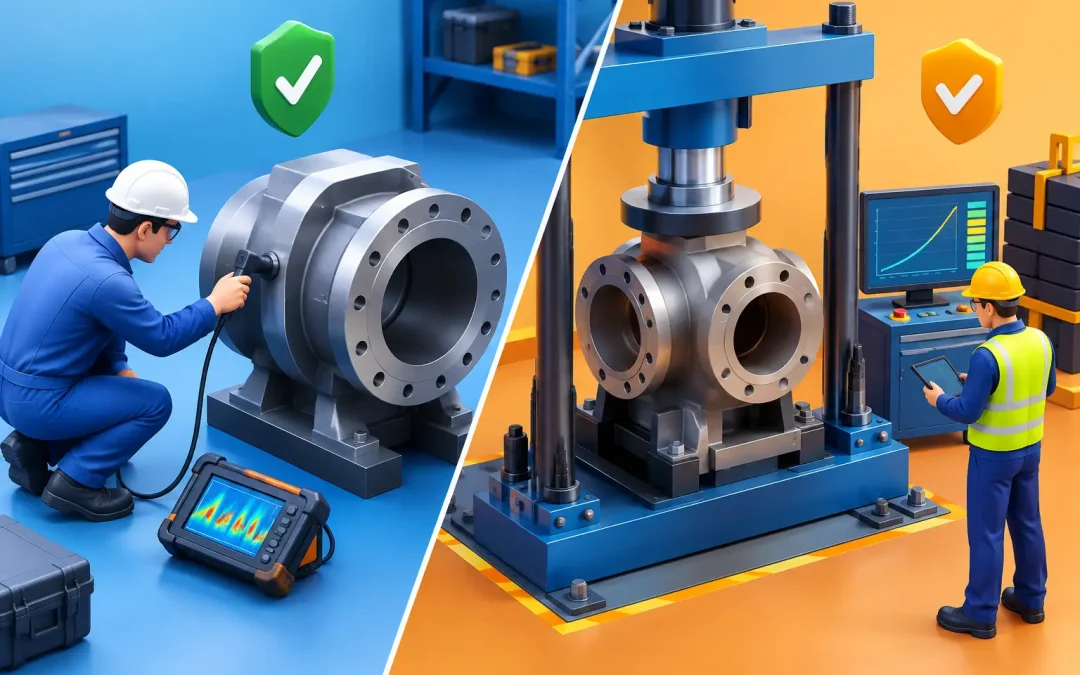
A lift can be ready to perform and still fail an inspection if the paperwork does not match what the inspector asked for. That is where proof testing vs load validation becomes more than a terminology question. Contractors, rigging crews, and equipment managers need to know whether the requirement calls for a documented proof load test, a validation of the full lifting setup, or both.
The difference affects your scope of work, schedule, documentation, and whether equipment can be released for service. Treating the terms as interchangeable can create avoidable delays at the worst possible time – when a crew, crane, vessel, or critical lift is waiting.
What Proof Testing Confirms
Proof testing is a controlled test in which a lifting device, component, or assembly is subjected to a specified load for a prescribed period or sequence. The purpose is to demonstrate that the item can withstand the required proof load without permanent deformation, damage, instability, or other failure criteria defined by the applicable requirement.
Depending on the equipment and governing standard, the proof load may be above the item’s rated working load limit. The test must be performed with the right setup, calibrated test equipment, and documented results. A visual inspection before and after the test is commonly part of the process because a component that holds the load but shows cracking, stretching, distortion, or damaged hardware may not be acceptable for service.
Proof testing is often required for lifting beams, below-the-hook devices, padeyes, rigging assemblies, davits, custom lifting fixtures, hoists, anchors, and fabricated lifting points. The actual requirement depends on the equipment type, its intended use, the project specification, the manufacturer, and the authority having jurisdiction.
A proof test is not simply putting weight on an item and taking a photo. A useful certification record should identify the equipment tested, the test load, the test method, the date, the result, and the party performing the work. If the item has a serial number or asset tag, that information should be recorded accurately. Inspectors need to connect the certificate to the actual equipment on the jobsite.
What Load Validation Usually Means
Load validation is a broader term. It generally means verifying that a component, lifting system, or installation performs as intended under expected load conditions. In some project documents, the phrase refers to confirming actual capacity. In others, it means validating load paths, load distribution, system behavior, or the suitability of an installed assembly.
For example, a custom lifting frame may pass a proof load test as a standalone device. Once that frame is paired with rigging, attachment points, a crane hook, and a specific load geometry, the project team may still need to validate the complete lift arrangement. Are the sling angles correct? Is the center of gravity where the lift plan says it is? Are the connection points loaded as designed? Does the system remain stable throughout the planned movement?
That is the practical distinction: proof testing focuses on demonstrating that an item withstands a prescribed test load. Load validation focuses on confirming that the actual equipment or system is appropriate for the intended loading condition and application.
The two can overlap, but one does not automatically replace the other.
Proof Testing vs Load Validation on a Real Jobsite
A common mistake is requesting a “load test” without providing the inspector’s wording, equipment details, or project requirement. The vendor may perform a valid test, but the resulting certificate may not satisfy the request because the scope was different from what the project needed.
Consider a fabricated lifting lug installed on a structural member. A proof test may be required to demonstrate the lug can carry the specified proof load. But if the lug is part of a larger engineered lifting arrangement, load validation may also involve the attachment condition, structural capacity, direction of pull, and load distribution. Testing only the lug does not validate every part of the system.
The reverse can also happen. A lift plan may show that calculated loads and sling angles are acceptable, but an inspector may still require a physical proof load test and certificate for the lifting beam or custom fixture. Engineering review, field validation, and proof load certification serve different purposes. Do not assume one document satisfies all three.
When You Need a Proof Load Test
Proof load testing is usually the right service when a specification, customer, inspector, manufacturer, or governing procedure explicitly requires a proof test certificate. It is especially common when equipment is custom fabricated, newly commissioned, repaired, altered, removed from service after damage, or being used on a high-consequence lift.
It may also be required before equipment can be used at a port, industrial facility, military project, utility site, or major construction project. These environments often have strict documentation controls, and a verbal assurance from the fabricator or field crew is not enough.
The required load, hold time, inspection criteria, and certificate format should be confirmed before testing begins. A 125% proof load requirement is not universal. Neither is a 150% requirement. The correct test load comes from the applicable standard, engineering direction, manufacturer requirement, or project specification.
If the requirement is unclear, get clarification before scheduling. Performing the wrong test can cost more time than waiting one day for a written answer.
When Load Validation Is the Better Question
Load validation matters when the concern is not just whether one device holds weight, but whether the complete operation will work safely as planned. This is common with engineered picks, unusual load geometry, temporary lifting systems, modified equipment, and assemblies with multiple load-bearing components.
For a full system review, the team may need information beyond the test item itself. That can include drawings, lift plans, rated capacities, rigging configuration, connection details, expected loading direction, and the weight and center of gravity of the load. If the equipment will be used differently than it was originally designed or tested, the original certificate may not apply to the new use.
Load validation can also reveal issues that a component-level proof test will not. A frame may be adequately rated, but the rigging angle may increase leg tension beyond acceptable limits. A lifting point may be sound, but an off-axis pull may be prohibited. A system may carry a static load but become unstable during travel or rotation.
Documentation Is What Keeps the Job Moving
For inspection-driven work, the test itself is only part of the deliverable. The paperwork must be clear enough for a superintendent, safety manager, owner representative, or inspector to review without chasing missing details.
Before mobilizing, provide the equipment description, identification numbers, rated capacity, required test load, available drawings, and any project-specific certificate language. If the item is a custom fabrication, share the dimensions and connection details early. If it is already installed, confirm site access, available test space, and whether the assembly can be safely loaded in place.
After testing, retain the certification with the equipment file and make sure the equipment is marked or tagged in a way that matches the record. If an asset tag is replaced, a serial number is unreadable, or the device is modified, the old certificate can become difficult to defend during an audit or inspection.
Avoid These Costly Assumptions
Do not assume that a manufacturer’s rated capacity is the same as a current proof test certificate. Do not assume a prior certificate applies after modification, repair, impact damage, or a change in use. And do not assume a test completed for one customer or project meets another site’s documentation requirements.
Also avoid waiting until the day of the inspection to identify the requirement. Mobile testing can reduce downtime, but even fast field service depends on having the correct scope, safe access, and the necessary test information ready. Pacific Load Testing helps San Diego-area teams bring the right testing and certification documentation to the jobsite so equipment does not sit idle longer than necessary.
The best next step is simple: read the exact inspection or project requirement, compare it to the equipment’s intended use, and confirm whether the request is for a proof test, a system validation, or separate documentation for each. That conversation before the test is what prevents a compliance problem after it.