
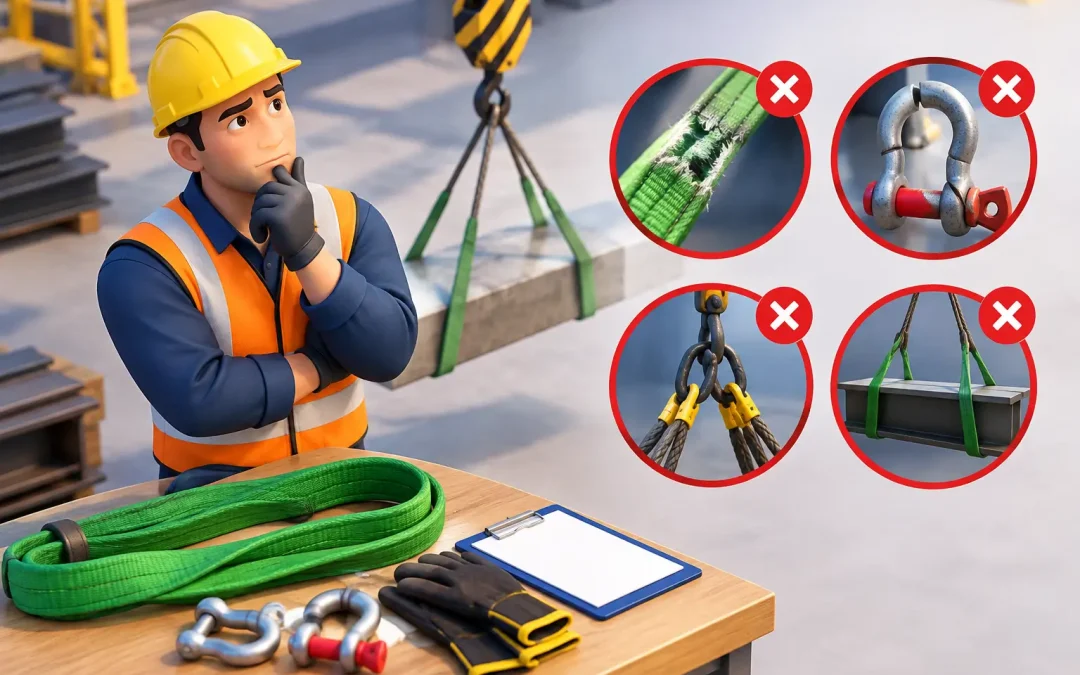
An inspector finds a missing tag, an expired record, or a test certificate that does not match the equipment in service. The lift stops, the crew waits, and the schedule absorbs the cost. The top rigging certification mistakes are usually preventable, but they tend to surface when a project is already under pressure.
Rigging certification is not paperwork for its own sake. It confirms that the gear, configuration, and supporting records meet the requirements for the work being performed. Whether the job involves a spreader beam, lifting lugs, below-the-hook devices, chain slings, wire rope slings, or a custom rigging assembly, the goal is the same: prove the equipment is ready before it is placed under load.
Top Rigging Certification Mistakes That Stop Work
Waiting until the inspection is scheduled
The most expensive mistake is treating proof load testing as a last-minute task. Contractors often discover a testing requirement only after an owner representative, safety manager, port authority, or third-party inspector asks for current documentation. By then, the equipment may be at a restricted site, attached to a structure, or needed for a lift the next morning.
Testing and certification take coordination. The equipment may need to be removed from service, cleaned for identification, transported, or tested in the field. A mobile testing provider can reduce that friction, but no provider can correct missing equipment data or an unavailable lifting point in the final hour.
Review certification requirements during procurement and before mobilization. If equipment is custom-built or modified, allow additional time. A standard sling may be straightforward. A fabricated lifting beam with multiple lift points, a special spreader arrangement, or a marine application may require more review before testing can proceed.
Assuming an old certificate covers the current setup
A certificate applies to the specific item and the conditions documented during testing. It does not automatically cover a changed configuration, a repair, an added component, or a different intended capacity. This is where otherwise careful crews get caught.
For example, a lifting beam may have a valid test record, but the record may not support a newly added lug, altered spacing, replacement hardware, or a different rigging arrangement. The same issue applies when several certified components are assembled into a system. Individual component records do not necessarily certify the assembled system at its planned working load.
Before requesting testing, compare the equipment in the field with the certificate in hand. Verify identification numbers, rated capacities, dimensions where applicable, attachment points, and the actual configuration to be used. If anything changed, flag it early.
Using capacity numbers without checking the full load path
The capacity stamped on one component is only one part of the lift. A rigging system is limited by its weakest component and by the forces created by the actual geometry. Sling angles, center of gravity, hitch type, connection hardware, side loading, and load distribution all matter.
A pair of slings may appear adequate based on vertical capacity, then become overloaded when used at a low angle. A shackle may carry the expected vertical load but be unsuitable for the pin size, connection shape, or direction of pull. A lifting lug can be rated for a specific loading direction and still be used incorrectly in the field.
Certification records should support the intended use, not just show that each part has a number stamped on it. Provide the expected load, pickup arrangement, sling angles, and any special site conditions when arranging testing. Clear job information helps prevent a test plan that does not match the lift.
Missing or unreadable equipment identification
If an item cannot be positively identified, its certification value drops quickly. Tags get painted over, serial numbers wear down, manufacturers’ markings are removed during repair, and paperwork becomes separated from the equipment. Then a crew has a certificate but cannot prove which piece it belongs to.
Maintain a simple equipment register with the item description, unique ID, rated capacity, inspection history, and current test documentation. Make the ID durable and visible without compromising the equipment. For gear exposed to salt air, welding activity, abrasion, or heavy handling, inspect markings more often.
Do not assume a handwritten label is enough for every application. The right identification method depends on the equipment type, owner requirements, and applicable standards. What matters is that the item can be clearly matched to its records when an inspector asks.
Documentation Errors That Create Rework
A proof load test may be completed successfully, yet the job can still be delayed by incomplete documentation. Inspectors and project teams need records that are clear, specific, and traceable. Generic paperwork creates questions, and questions create downtime.
Providing incomplete test information
A useful certificate identifies the customer, equipment, unique identifier, test date, test load, capacity or working load limit, and the result. Depending on the equipment and project requirements, it may also need to describe the configuration, test method, dimensions, load points, or any limitations on use.
The details need to agree with the equipment in the field. A certificate that says “lifting beam” without a serial number, rated capacity, or clear description may not satisfy an inspector. Neither will a report that lists a test load but does not identify the item tested.
Send the available drawings, prior certificates, manufacturer information, and project requirements before the test whenever possible. That allows the testing team to identify gaps before equipment is on the test stand or at the jobsite.
Confusing inspection with proof load testing
Visual inspections, periodic inspections, and proof load tests serve different purposes. An inspection can identify wear, deformation, corrosion, damaged hardware, or missing markings. A proof load test applies a specified load to verify performance under controlled conditions. One does not automatically replace the other.
The required combination depends on the equipment, its use, the governing standard, the customer specification, and the authority having jurisdiction. Do not tell an inspector that an item is “certified” without knowing what that term means for the project. Ask whether the requirement is for a visual inspection, a proof load test, a fabrication record, a third-party certificate, or all of these.
This distinction matters most on high-consequence projects. Marine work, critical lifts, public-facing areas, and projects with strict owner specifications often require tighter documentation than routine material handling.
Field Conditions That Undermine a Good Plan
Rigging can pass testing and still become unsuitable through field damage or uncontrolled changes. Certification should be part of an active equipment-control process, not a file that is reviewed once and forgotten.
Watch for damage after transport, welding exposure, impact, overload events, chemical exposure, and unauthorized modification. Remove questionable equipment from service until a qualified person can evaluate it. Do not attempt to solve a schedule problem with a field repair that has not been reviewed and documented.
Also plan the testing location. A proof load test needs safe access, adequate space, stable conditions, and a way to apply and measure the required load. Equipment installed at elevation, inside a congested facility, or on a secured waterfront site may require site coordination before a mobile crew can work efficiently.
A Better Way to Prepare for Certification
Before a lift-critical deadline, verify the equipment list against the actual gear on site. Confirm each item has readable identification, current records, and a capacity appropriate for the intended configuration. Then gather the project specification, drawings, load information, and inspection requirements in one place.
For custom or modified gear, involve the testing provider before the equipment reaches the jobsite. Pacific Load Testing can coordinate on-site proof load testing to help San Diego contractors obtain the documentation needed for inspection and release. The earlier the equipment details are reviewed, the less likely a simple certification issue becomes a missed work shift.
The best time to address rigging certification is when the equipment is still accessible and the schedule has options. Get the right records matched to the right gear, confirm the planned lift conditions, and keep the documentation where the field team can produce it when asked.