
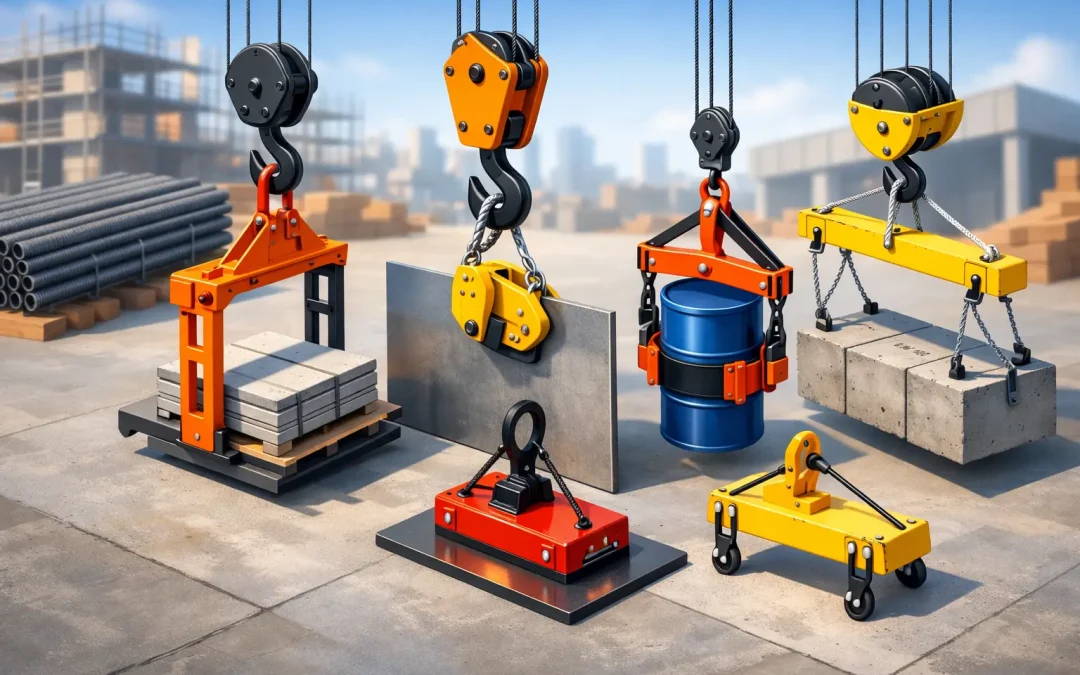
A guide to below hook devices starts where the lift actually happens: between the crane hook and the load. This equipment may look straightforward, but it carries the full consequence of a bad fit, an undocumented repair, or a missed inspection. When an inspector asks for certification, your crew needs more than a rated tag. You need equipment that is correctly selected, verified, and ready to use.
Below-the-hook devices are often used under schedule pressure. A steel package needs to be turned, a precast panel needs controlled placement, or a fabricated assembly needs to clear an obstruction without side loading the rigging. The right device makes the lift controlled and repeatable. The wrong device can stop the job before the first pick.
What Are Below Hook Devices?
Below hook devices, also called below-the-hook lifting devices, are lifting assemblies that connect to a crane or hoist hook and support, secure, position, or rotate a load. They are different from basic rigging hardware because they are generally engineered or fabricated as a complete device for a defined lifting purpose.
Common examples include lifting beams, spreader beams, plate clamps, lifting frames, C-hooks, coil lifters, pallet lifters, pipe lifting devices, lifting magnets, vacuum lifters, and custom fabricated lifting fixtures. A device may use slings, shackles, hooks, pins, or lugs as part of its assembly, but the capacity of the complete system matters most.
A lifting beam and a spreader beam are a good example of why terminology matters. A lifting beam typically handles load through bending in its main beam. A spreader beam uses a compressive member and upper rigging arrangement to keep sling angles under control. Both can support a load, but their loading paths, connection points, and inspection concerns are not the same.
Selecting the Right Device for the Lift
The rated capacity marked on a device is only one part of the decision. Capacity must match the planned lift, but the device also has to work with the load shape, center of gravity, pick points, available headroom, crane hook arrangement, and rigging geometry.
Start with the actual load weight, including anything permanently attached during the pick. Then verify the center of gravity. A device that is adequate for a centered load may become unsuitable when the load is offset, uneven, or prone to shifting. If the center of gravity is not known, treat that as a planning issue to resolve before lifting.
Connection compatibility is equally important. Hook openings, shackle pin diameters, padeye sizes, lug thicknesses, and sling attachment locations must fit without forcing components into side loading or binding. Do not make a connection work by using an undersized shackle, a modified pin, or a field-made spacer with no engineering basis.
Headroom can drive the selection on congested jobsites. A long rigging arrangement may reduce available lift height enough to make a device impractical, even when its rated capacity is sufficient. A lower-profile lifting beam, purpose-built frame, or alternate pick configuration may be the safer answer.
For custom lifts, the device must be designed for the use it will see. That includes the intended load, pick points, sling angles, and handling method. A fabricated fixture is not automatically acceptable because it has held a similar load before. If it has no defined capacity, no identification, or no supporting documentation, it can become a compliance problem quickly.
Markings That Need to Be Legible
A properly identified device gives the crew and inspector the information needed to make a basic field verification. Markings should be permanent, legible, and tied to the device itself. At minimum, crews commonly need to see the manufacturer or fabricator identification, serial or identification number, rated load, and other applicable operating limitations.
Those limitations may include approved lift points, permitted load orientation, maximum sling angle, required rigging configuration, or restrictions on side loading. A magnetic lifter may have different capacities based on material thickness and surface condition. A plate clamp may be limited by plate thickness, hardness, or whether it is being used in a vertical or horizontal orientation. The tag and instructions are part of the device, not paperwork to ignore in the gang box.
If a capacity tag is missing or unreadable, remove the device from service until its identification and rating can be verified. Replacing a tag without confirming the underlying information does not solve the problem. The replacement marking must be supported by reliable records, manufacturer information, or qualified engineering review.
Inspection Before the Device Goes to Work
Pre-use inspection is the operator’s first chance to catch damage, wear, or alteration. This is a hands-on check before the lift, not a quick glance from the truck bed. Look at the full load path: hook connections, pins, lugs, welds, structural members, moving parts, locking mechanisms, and attachment points.
Pay close attention to cracks, bent members, damaged threads, elongated holes, spread hooks, missing retainers, unauthorized weld repairs, corrosion, heat damage, and evidence of overload. On a lifting beam or frame, a small crack near a lug or weld can be a serious finding. On a clamp, worn gripping surfaces or a malfunctioning latch can make the rated capacity meaningless.
Functional components deserve the same attention as structural steel. Test latches, locks, brakes, rotation controls, hydraulic functions, vacuum indicators, and electrical controls according to the device’s instructions. A device may look sound while a control or safety interlock is not functioning correctly.
Formal periodic inspection is separate from the pre-use check. Frequency depends on the device type, service conditions, manufacturer requirements, and applicable workplace rules. Heavy use, corrosive exposure, outdoor storage, impact risk, and prior damage can justify more frequent inspection. Keep inspection records organized by device ID so the equipment on the job can be matched to its paperwork without delay.
When Proof Load Testing Is Needed
Proof load testing verifies that a below-hook device can withstand a specified test load under controlled conditions. It is commonly required for new fabricated devices, repaired or altered equipment, equipment with uncertain history, and job-specific or inspector-driven acceptance requirements.
The required test load and test method depend on the device, applicable standard, manufacturer instructions, customer specifications, and project requirements. There is no safe one-size-fits-all percentage to apply across every beam, clamp, lifter, or custom fixture. Testing the wrong configuration can fail to verify the actual service condition, or worse, introduce damage.
A proper test plan identifies the device, rated capacity, rigging arrangement, test load, load application method, hold period where required, inspection points, and acceptance criteria. The device should be examined before and after testing for permanent deformation, cracking, damage to welds, malfunctioning components, or other signs that it is not fit for service.
Proof testing is not just about applying weight. The setup must control the load and protect the people conducting the test. Clear the area, use suitable test equipment, verify rigging capacity, and keep personnel away from suspended or tensioned loads. A documented test performed under controlled conditions is far more useful than an informal field lift with unknown weight.
Documentation That Keeps the Job Moving
When an inspector requests certification, the fastest response is a clean package tied to the exact device in use. That package may include the device identification, rated capacity, inspection record, proof load test certificate, test date, test load, results, and notes about any limitations or repairs.
Make sure the serial number or unique ID on the certificate matches the marking on the equipment. A generic certificate for a similar beam will not establish that the beam on your jobsite was tested. This mismatch is one of the most avoidable reasons equipment gets sidelined during an inspection.
For repaired or modified devices, retain records that describe what changed and how the device was evaluated afterward. Welding a new lug, adding a pick point, changing a structural member, or modifying a locking mechanism can affect capacity and may require engineering review and retesting before the device returns to service.
Pacific Load Testing provides mobile proof load testing and certification support for lifting equipment in the San Diego area. On-site service can reduce transport delays and help project teams get the documentation needed for inspection-driven work.
Keep Below Hook Devices Ready, Not Just Available
The best time to verify a below-hook device is before it becomes the critical path item on a lift plan. Identify it, inspect it, confirm its intended use, and keep its records with the equipment file. If the device has been damaged, altered, or cannot be matched to valid documentation, stop and resolve that issue before the crew is waiting under a crane.
A certified device does more than satisfy an inspection request. It gives the operator, rigger, supervisor, and customer a clear basis for making the lift with the right equipment and fewer jobsite surprises.