
A failed inspection over missing proof load documentation can stop a lift before it starts. When a lifting beam load test is required, the issue is not just whether the beam looks sound. The issue is whether it has been tested, documented, and approved for the job in front of you.
For contractors, rigging teams, plant operators, and port or marine crews, that distinction matters. A lifting beam may be well-built and still not pass inspection if the paperwork is missing, outdated, incomplete, or tied to the wrong configuration. On a busy schedule, that can turn into lost hours, rescheduled picks, and avoidable downtime.
What a lifting beam load test actually proves
A lifting beam load test verifies that the beam can safely handle its rated load under controlled test conditions. It is not a visual guess and it is not a paperwork exercise alone. The test is meant to confirm that the beam, its structure, and its lifting points perform as intended when subjected to a proof load.
In most field situations, the goal is straightforward. You need documented evidence that the lifting beam has been tested to the required standard and is acceptable for service. That documentation is often what the inspector, safety manager, customer, or project owner is waiting on before approving use.
This is where confusion starts. Some teams assume that a manufacturer tag or fabrication record is enough. Sometimes it is, but often it is not. If the beam is custom-built, modified, repaired, brought onto a new site, or requested by an inspector for verification, a proof load test may be required before it can be used.
When a lifting beam load test is usually needed
It depends on the equipment history and the project requirements. A new beam may need initial proof testing before first use. A custom beam often needs testing because the jobsite or owner wants direct confirmation of rated capacity. A repaired or altered beam may need to be retested because the original certification no longer covers its current condition.
There are also cases where the beam itself is fine, but the documentation trail is the problem. Missing records, unreadable nameplates, uncertain load ratings, or inconsistent serial identification can all trigger a requirement for testing and recertification.
For inspection-driven projects, timing matters as much as the test itself. If the beam is needed for a scheduled pick, shutdown, or installation sequence, waiting until the day before can create unnecessary pressure. A lifting beam load test should be treated as part of job readiness, not a last-minute scramble.
What inspectors and project teams are looking for
Most inspectors are not trying to make the job harder. They want to confirm that the lifting device is rated, tested, and documented for safe use. That usually means they are looking at a few practical things: identification, rated capacity, condition, proof load test results, and current certification paperwork.
If any one of those pieces is missing, the beam may be held out of service until the issue is resolved. That is why speed alone is not enough. The testing process has to produce documentation that matches the beam and satisfies the site requirement.
That includes basic but critical details such as the beam description, serial or asset identification, rated load, test load applied, date of test, and certification record. If the beam has special rigging geometry, below-the-hook attachments, or multiple lift points, those details may also need to be reflected in the test and paperwork.
How the load test process works
A proper lifting beam load test starts with identifying exactly what is being tested. That sounds obvious, but on active jobsites equipment is often moved, repainted, modified, or tracked under internal asset numbers that do not match old records. Before any proof load is applied, the beam needs to be verified against whatever documentation exists.
From there, the beam is visually assessed for obvious issues such as deformation, weld concerns, damaged connection points, missing markings, or signs of prior overload. Visual inspection does not replace testing, but it does help catch problems that should be addressed before the proof load is applied.
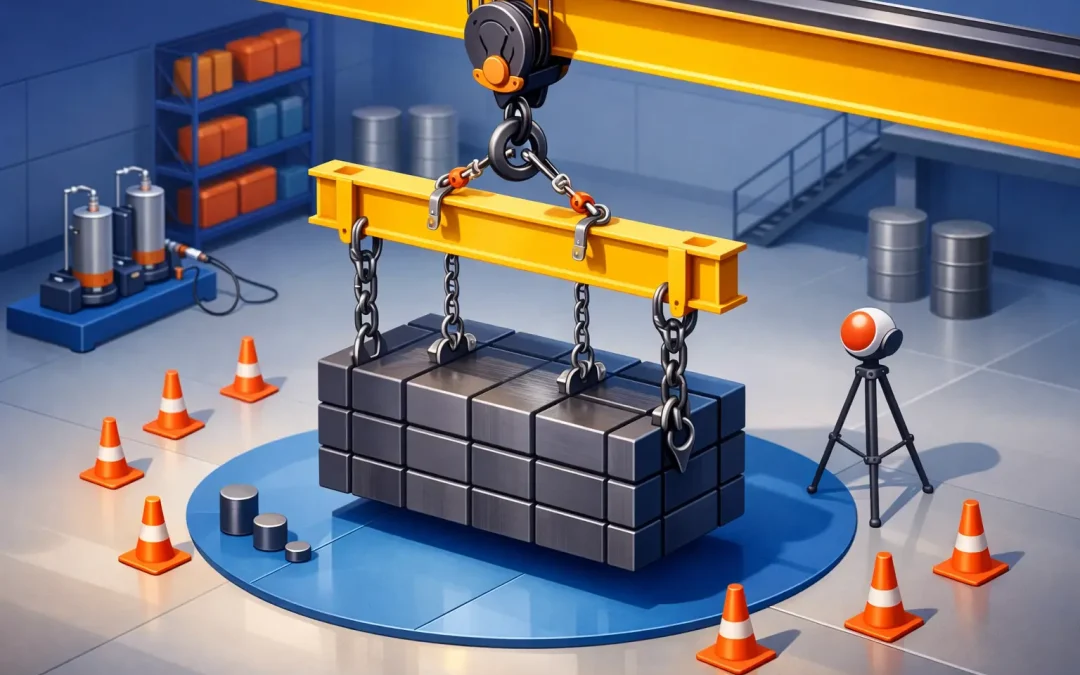
The actual test applies a specified load under controlled conditions. The test setup matters. Load application, support points, rigging arrangement, and measurement all need to reflect the beam’s intended service configuration as closely as practical. A test done under the wrong setup may not satisfy the requirement, even if the beam itself performs well.
After the load is applied and the beam is evaluated, documentation is issued if the equipment passes. That paperwork is the part your field team, inspector, or customer will rely on to approve use.
Common reasons beams fail testing or certification review
Not every problem is a structural failure. In fact, many delays come from issues that are preventable. A beam may be removed from service because the capacity marking is missing, the identification cannot be verified, the beam was modified without updated engineering, or the paperwork does not match the equipment presented.
There are also true equipment issues. Bent members, suspect welds, damaged pad eyes, worn shackles used as part of the assembly, or evidence of heat damage and corrosion can all create problems during review. In those cases, the right move is not to push for paperwork anyway. It is to correct the issue, then retest as required.
For operations teams, this is where a practical testing partner matters. You need clear answers on whether the beam is ready to test, whether repair is needed first, and what documentation will be required once the beam is approved.
Why mobile testing matters on tight schedules
Moving heavy lifting gear off site is not always practical. It adds transport time, coordination, and another layer of delay to work that is usually already on a clock. For many contractors and industrial operators, mobile field service is the difference between staying on schedule and losing a day or more to logistics.
On-site service also helps reduce confusion. The beam can be identified where it is being used, the project team can confirm asset information in real time, and the certification need can be tied directly to the equipment the inspector is reviewing. That is often faster than shipping equipment out, waiting in a queue, and sorting out paperwork after the fact.
For San Diego-area contractors and operators, Pacific Load Testing is built around that reality. The focus is simple: come to the site, perform the required proof load testing, and help get the documentation in place so work can move.
How to avoid delays before calling for a lifting beam load test
A little prep saves time. Before scheduling a test, confirm the beam’s identification, rated capacity, and current condition. Gather any existing certification, manufacturer information, fabrication drawings, or prior test records. If the beam has been modified or repaired, say so up front. That is not a red flag. It just affects what is needed.
It also helps to be clear about the job requirement. Some sites want fresh certification before use. Others want verification after repair, after relocation, or before a specific inspection milestone. If you know what the inspector or owner is asking for, the testing process can be aligned to that requirement from the start.
Space and access matter too. If the test is being performed on site, make sure there is room to stage equipment safely and that the beam is available when the technician arrives. Delays often come from coordination issues, not the test itself.
Documentation is what keeps the job moving
The physical test is only half the job. The other half is usable certification. If the paperwork is delayed, incomplete, or unclear, the project can still stall. That is why contractors and site supervisors should treat documentation as part of operational readiness, not an afterthought.
Good certification records help with more than one inspection. They support internal asset control, simplify future audits, and make it easier to verify compliance when equipment moves between projects or facilities. They also reduce the chance of field arguments about whether a beam is approved for use.
When the requirement is urgent, the value is simple: tested equipment, matched documentation, and fewer reasons for an inspector to hold up the work.
If you have a lifting beam that needs approval, the best time to handle the load test is before it becomes the reason the pick is delayed. Get it identified, get it tested, and get the paperwork in hand so the crew can get back to work.